Jesus Knew Before He Died That He Would Rise Again.
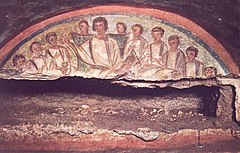
Early Christian Catacomb painting of Jesus and his disciples, pre-3rd century.
There are several references in the Synoptic Gospels (the gospels of Matthew, Marking and Luke) to Jesus predicting his own expiry, the first two occasions building up to the concluding prediction of his crucifixion.[1] Matthew'southward Gospel adds a prediction, before he and his disciples enter Jerusalem, that he volition be crucified there.[two]
Gospel of Marker [edit]
In the Gospel of Marker, by and large agreed to be the primeval Gospel, written around the yr seventy,[3] [four] Jesus predicts his death three times. Scholars note that this Gospel also contains verses in which Jesus appears to predict his Passion and propose that these represent the before traditions bachelor to the writer/ Some scholars, such equally Walter Schmithals, suggest a redactional formulation of the writer, though Schmithals states there are "vexxing questions" relating to the sayings.[5] Meanwhile, other scholars clarify these arguments and present a dissimilar view, and believe these sayings are historical. Ultimately, no consensus has emerged amidst scholars.[half dozen] The setting for the beginning prediction is somewhere nigh Caesarea Philippi, immediately afterward Peter proclaims Jesus as the Messiah. Jesus tells his followers that "the Son of Man must suffer many things and be rejected by the elders, chief priests and teachers of the law, and that he must be killed and after iii days rise again".[vii] When Peter objects, Jesus tells him: "Become behind me, Satan! Yous do non take in mind the things of God, simply the things of men". (Mark 8:31–33)
Gospel of Matthew [edit]
The Gospel of Matthew xvi:21–28 includes this episode,[8] saying that Jesus "from that time", i.eastward. on a number of occasions, Jesus "began to evidence his disciples that he must become to Jerusalem and suffer many things from the elders and chief priests and scribes, and exist killed ...".[9]
The Gospel of Luke ix:22–27 shortens the account, dropping the dialogue between Jesus and Peter.
Each time Jesus predicts his arrest and expiry, the disciples in some way or some other manifest their incomprehension, and Jesus uses the occasion to teach them new things.[ten] The second warning appears in Mark nine:30–32 (and likewise in Matthew 17:22–23) as follows:
He said to them, "The Son of Man is going to exist betrayed into the hands of men. They volition kill him, and after 3 days he will rise." Only they did not understand what he meant and were agape to ask him about it.[xi]
The tertiary prediction in Matthew xx:17–19 specifically mentions crucifixion:
Now as Jesus was going upwardly to Jerusalem, he took the twelve disciples aside and said to them, "We are going upwards to Jerusalem, and the Son of Man volition exist betrayed to the chief priests and the teachers of the police. They volition condemn him to death and will turn him over to the Gentiles to be mocked and flogged and crucified. On the third twenty-four hour period he will exist raised to life!"[12]
The 4th prediction in Matthew is institute in Matthew 26:1–2, immediately before the plot made against him by the religious Jewish leaders:
-
- "As you know, the Passover is 2 days away — and the Son of Homo will exist handed over to be crucified."
The hypothetical Q source, widely considered by scholars to be a drove of sayings of Jesus used, in addition to the Gospel of Marking, past the authors of the Luke and Matthew Gospels, contains no predictions of the expiry of Jesus.[13]
Gospel of John [edit]
In the conversation with Nicodemus in the Gospel of John, Jesus pointed Nicodemus towards his death when he said
Only equally Moses lifted up the snake in the wilderness, so the Son of Man must be lifted up[14]
Jesus was intimating that something like would happen to him every bit in Numbers 21:4-nine,[fifteen] where Moses raised a bronze statue of a serpent upwardly on a pole.
In chapters 12 to 17 this gospel also mentions several occasions where Jesus prepared his disciples for his departure, which the gospel too refers to every bit his "glorification":[sixteen]
Jesus answered them, proverb, "The hour has come up that the Son of Human should be glorified. Most convincingly, I say to you lot, unless a grain of wheat falls into the footing and dies, information technology remains alone; simply if information technology dies, it produces much grain.[17]
Comparison of Synoptic Gospel predictions [edit]
In each of the Synoptic Gospels, Jesus foretells of His ain death and resurrection after 3 days. The concordances are summarized in the following table:
| Matthew | Marker | Luke |
|---|---|---|
| Matthew 16:21-23: From that time Jesus began to show to His disciples that He must go to Jerusalem, and suffer many things from the elders and chief priests and scribes, and be killed, and exist raised the third twenty-four hour period. And then Peter took Him aside and began to rebuke Him, saying, "Far be it from You lot, Lord; this shall not happen to You!" But He turned and said to Peter, "Become behind Me, Satan! You are an offense to Me, for you are not mindful of the things of God, but the things of men."[1] | Mark 8:31-33: And He began to teach them that the Son of Man must suffer many things, and be rejected past the elders and master priests and scribes, and be killed, and after three days ascension again. He spoke this word openly. Then Peter took Him bated and began to rebuke Him. But when He had turned around and looked at His disciples, He rebuked Peter, saying, "Get behind Me, Satan! For you lot are non mindful of the things of God, only the things of men."[2] | Luke nine:21-22: And He strictly warned and commanded them to tell this to no 1, saying, "The Son of Man must suffer many things, and be rejected past the elders and chief priests and scribes, and be killed, and exist raised the third day."[three] |
| Matthew 17:22-23: Now while they were staying in Galilee, Jesus said to them, "The Son of Human being is almost to be betrayed into the hands of men, and they will impale Him, and the third day He will be raised upwardly." And they were exceedingly sorrowful.[4] | Mark 9:30-32: And so they departed from there and passed through Galilee, and He did not want anyone to know information technology. For He taught His disciples and said to them, "The Son of Human is being betrayed into the hands of men, and they will kill Him. And after He is killed, He will ascent the third solar day." Merely they did not understand this maxim, and were afraid to ask Him.[5] | Luke 9:43-45: Simply while everyone marveled at all the things which Jesus did, He said to His disciples, "Let these words sink down into your ears, for the Son of Human is about to exist betrayed into the easily of men." But they did not sympathize this proverb, and it was hidden from them and so that they did non perceive it; and they were agape to ask Him most this saying.[half-dozen] |
| Matthew 20:17-19: Now Jesus, going up to Jerusalem, took the twelve disciples bated on the road and said to them, "Behold, we are going up to Jerusalem, and the Son of Man will be betrayed to the chief priests and to the scribes; and they volition condemn Him to expiry, and deliver Him to the Gentiles to mock and to scourge and to excruciate. And the third 24-hour interval He will rise again." [vii] | Marking 10:32-34: Now they were on the road, going upward to Jerusalem, and Jesus was going before them; and they were amazed. And every bit they followed they were afraid. Then He took the twelve aside again and began to tell them the things that would happen to Him: "Behold, we are going up to Jerusalem, and the Son of Man volition exist betrayed to the main priests and to the scribes; and they will condemn Him to expiry and deliver Him to the Gentiles; and they will mock Him, and [a]scourge Him, and spit on Him, and kill Him. And the third day He will ascent again[viii] | Luke 18:31-34: Then He took the twelve bated and said to them, "Behold, we are going up to Jerusalem, and all things that are written by the prophets apropos the Son of Human being volition be accomplished. For He will exist delivered to the Gentiles and volition be mocked and insulted and spit upon. They will scourge Him and kill Him. And the third 24-hour interval He will ascension once more." Only they understood none of these things; this maxim was hidden from them, and they did not know the things which were spoken.[9] |
| Matthew 26:32 But after I have risen, I will go ahead of yous into Galilee."[18] |
As shown in the Daily Mass Readings provided in the Latin Rite of the Roman Catholic Church,[19] the prediction given past Jesus in Mark 9:32 has one of its main references in the Wisdom of Solomon:[20]
12 Therefore let us lie in look for the righteous; considering he is not for our turn, and he is make clean reverse to our doings: he upbraideth u.s. with our offending the constabulary, and objecteth to our infamy the transgressings of our education. 17 Permit us come across if his words be true: and let u.s.a. prove what shall happen in the end of him. For if the simply homo be the son of God, he will help him, and deliver him from the hand of his enemies. Let us examine him with despitefulness and torture, that we may know his meekness, and prove his patience. Allow u.s. condemn him with a shameful expiry: for by his ain saying he shall be respected.
—Book of Wisdom 2:12, 17-20 (KJV translation)
Historical context [edit]
Jesus made predictions nigh the "Son of Human being." This is a Hebrew term with five different meanings, depending on the context in which it is used: all mankind (humanity every bit a whole), a human beingness (a man, as opposed to God), a personal pronoun ("I", "myself"), a sinner (an unjust person, as opposed to a but person),[21] and the messiah (the awaited king).[22]
Jesus predicted that the Son of Homo would exist handed over/betrayed to the elders, the primary priests, the scribes, and the teachers of the law. In the Second Temple period, the Sanhedrian members were called "elders,"[23] a high priest was a "master priest,"[24] and the successors of Ezra the scribe - who became teachers of the police in those days - were called the "scribes."[25] [26] John xviii relate that Jesus was tried by the ii master priests at the time, Annas and Caiaphas.[27]
Jesus likewise predicted that the Son of Man would be crucified by the Romans/Gentiles. The Hebrew word gentile means non-Jewish people.[28] Judaism does not allow crucifixion every bit a means of punishment,[29] but Aboriginal Roman law did allow sure persons, such every bit slaves and pirates, to exist crucified.[thirty] [31]
Run into likewise [edit]
- Chronology of Jesus
- Jesus predicts his betrayal
- Life of Jesus in the New Testament
Notes [edit]
- ^ St Mark's Gospel and the Christian organized religion by Michael Keene 2002 ISBN 0-7487-6775-4 pages 24-25
- ^ The Temptations of Jesus in Mark's Gospel by Susan R. Garrett 1996 ISBN 978-0-8028-4259-6 pages 74-75
- ^ Witherington (2001), p. 31: 'from 66 to 70, and probably closer to the latter'
- ^ Hooker (1991), p. 8: 'the Gospel is ordinarily dated between Advert 65 and 75.'
- ^ Walter Schmithals, The Theology of the First Christians (Westminster John Knox Press, 1997) page 22.
- ^ Licona, Michael (2021). "Did Jesus Predict his Decease and Vindication/Resurrection?". Journal for the Report of the Historical Jesus. eight: 47–66. doi:10.1163/174551909X12607965419595.
{{cite journal}}: CS1 maint: url-status (link) - ^ The Gospel according to Mark: significant and message by George Martin 2005 ISBN 0-8294-1970-five pages 200-202
- ^ Matthew for Everyone: Chapters xvi-28 by Tom Wright 2004 ISBN 0-664-22787-2 page 9
- ^ Matthew 16:21
- ^ Mercer Dictionary of the Bible by Watson Eastward. Mills, Roger Aubrey Bullard 1998 ISBN 0-86554-373-ix page 550
- ^ "Bible Gateway passage: Marking 9:thirty-32 - New Revised Standard Version".
- ^ Matthew 20:17–19
- ^ John South Kloppenborg, Q, the Earliest Gospel (Westminster John Knox Press, 2008) folio 75.
- ^ John 3:14
- ^ Numbers 21:4–9
- ^ Dictionary of biblical imagery by Leland Ryken, Jim Wilhoit, Tremper Longman, Colin Duriez, Douglas Penney, Daniel G. Reid 1998 ISBN 0-8308-1451-five page 269
- ^ John 12:23–24
- ^ "Bible Gateway passage: Matthew 26:32 - New International Version". Bible Gateway . Retrieved 2019-04-27 .
- ^ "Daily Mass Readings - 23 September 2018 – Sunday". catholiewtn.com. Archived from the original on November 21, 2018.
- ^ "The 1611 King James Bible. Book of Wisdom, affiliate, vv. 12, and 17 to 20". kingjamesbibleonline.org. Archived from the original on June 28, 2012.
- ^ Jewish Encyclopedia: Son of Man The rendering for the Hebrew "ben adam," applied to mankind in general, as opposed to and distinct from not-human relationship; expressing also the larger, unlimited implications of humanity equally differentiated from limited (e.thousand., national) forms and aspects of man life...The New Testament expression ὅ ὑιὸς τοῦ ἀνθρόπου is a translation of the Aramaic "bar nasha," and as such could have been understood only as the substitute for a personal pronoun, or equally emphasizing the human being qualities of those to whom it is applied..."Sons of men," or "children of men," designates too the slanderers and evil-doers in contrast to the righteous, that is, State of israel (Ps. lvii. 5 [A. V. 4], lviii. 2 [A. Five. one]).
- ^ Jewish Encyclopedia: Messiah The Messiah is called "the Son of Homo," and is described as an angelic being, his countenance resembling a homo'southward, and as occupying a seat in heaven abreast the Aboriginal of Days (xlvi. 1), or, as it is expressed in ch. xxxix. vii, "under the wings of the Lord of spirits."...In the Assumptio Mosis, however (c. four B.C.), it may be concluded, on the ground of the identification of the Son of Human being = Messiah with Enoch = Meṭaṭron in Enoch lxxi. 14, that it is the preexistent Messiah who is referred to (x. 2), for it is stated that, at the end of the concluding tribulation, when God's rule will be established over all creation, "the hands of the affections who stands in the highest identify will be filled, and he will immediately avenge them [State of israel] on their enemies."
- ^ Jewish Encyclopedia: Sanhedrin Antiochus Five. also greeted the gerusia in a letter to the Jewish people. This gerusia, which stood at the caput of the people, was the body that was subsequently chosen "sanhedrin." The appointment and the manner of its origin can not at present exist determined. Josephus calls it either συνέδριον or βουλή, and its members πρεσβΎτεροι (="elders," i.e., ) or βουλευταί (="councilors"), whose number was probably the same every bit that of the members of the Sanhedrin in the hall of hewn rock, namely, seventy or seventy-one.
- ^ Jewish Encyclopedia: Priest Besides the "main priest" ("kohen ha-rosh") mention is made of the "kohen mishnch," the one holding the second place (2 Kings xxv. 18 et al.).
- ^ Jewish Encyclopedia: Scribe Body of teachers whose part was to translate the Law to the people, their organization get-go with Ezra, who was their chief, and terminating with Simeon the Just.
- ^ Jewish Encyclopedia: Education The men thus engaged are designated equally V05p043011.jpg or V05p043012.jpg, i.e., expounders of the Torah. Here for the kickoff fourth dimension in Jewish history is an organized body of teachers. The Prophets had been replaced by the priests; these in plough were succeeded by the scribes, "the wise" (comp. B. B. 12a, V05p043013.jpg). The latter are described in Dan. xii. 3 as the teachers, V05p043014.jpg; "they that be wise shall shine as the brightness of the firmament; and they that turn many to righteousness, as the stars for ever and ever." The Talmud refers the second clause to the teachers.
- ^ USCCB John eighteen:19-24 The loftier priest questioned Jesus...Then Annas sent him bound to Caiaphas the high priest.
- ^ The Cambridge history of Judaism, Volume two, Cambridge Academy Printing, 1989, p. 193. ISBN 978-0-521-24377-3
- ^ Jewish Encyclopedia: Crucifixion Amid the modes of Death penalty known to the Jewish penal law, crucifixion is non establish; the "hanging" of criminals "on a tree," mentioned in Deut. xxi. 22, was resorted to in New Testament times simply afterwards lapidation (Sanh. vi. 4; Sifre, ii. 221, ed. Friedmann, Vienna, 1864).
- ^ Robison, John C. (June 2002). "Crucifixion in the Roman World: The Use of Nails at the Time of Christ". Studia Antiqua. ii.
- ^ Zias, Joseph (1998). "Crucifixion in Antiquity: The Evidence". www.mercaba.org . Retrieved March x, 2018.
References [edit]
- Books
- Barclay, William (2001). The Gospel of John, Volume 1. Westminster John Knox Press. ISBN9780664237806.
- Davies, Stevan L. (2004). The Gospel of Thomas and Christian Wisdom. Bardic Press. ISBN9780974566740.
- Fitzmyer, Joseph A. (1985). The Gospel According to Luke, 10-XXIV. The Ballast Bible Reference Library. Doubleday. ISBN9780300139815.
- Harrington, Daniel J. (1991). The Gospel of Matthew. Liturgical Press. ISBN9780814658031.
- Hooker, Morna (1991). The Gospel According to Saint Mark. Continuum. ISBN9780826460394.
- Witherington, Ben (2001). The Gospel of Mark: A Socio-Rhetorical Commentary. Eerdmans Publishing. ISBN9780802845030.
Source: https://en.wikipedia.org/wiki/Jesus_predicts_his_death
0 Response to "Jesus Knew Before He Died That He Would Rise Again."
Post a Comment